Months later, by someone reconstructing decisions from memory and a
notebook nobody can re-run.
02
Fairness testing happens once
In a notebook, before launch, and then never again — because
repeating it is a week of somebody's time each quarter.
03
Decisions cannot be reproduced
An examiner asks about an applicant from March. Nobody recorded
which model version scored them, so nobody can answer.
04
Monitoring nobody reads
Dashboards that alert on p-values, which at scale means alerting on
everything, which means alerting on nothing.
It is a systems problem. So the fix is a system, not a longer checklist.
Interactive · the real model
Score an applicant. Watch what comes out with it.
These controls drive the deployed model, not an illustration. Every score
here is written to the append-only ledger, because a system that claimed
otherwise on its own marketing page would be lying about the one thing it
is for.
There is no control here for race, ethnicity, sex, or age. The
request schema has no field to put them in — enforced by a test,
not by discipline.
Reproducible and tamper-evident
“Explain the decision you made on this applicant in March.”
Every decision is a row chained to the one before it by SHA-256.
Append-only is enforced by database triggers, not by convention.
Retrieval walks the chain from genesis, loads the exact model version the
decision was made with, and re-scores the stored application.
○Walk the hash chain from genesis
○Load the pinned model version
○Re-score the stored application
What this does not do
The triggers stop accidents and the chain detects tampering. Neither stops
someone with write access to the file who drops the triggers and recomputes
every hash after it. Making a ledger tamper-proof needs the head
hash anchored outside the system, which is not built here — and saying so
is worth more than pretending otherwise.
Fairness testing as code
Three analyses, on data the model has never seen.
Measured on the out-of-time year, which is both the larger sample and the
stronger claim. These are live figures from the running system.
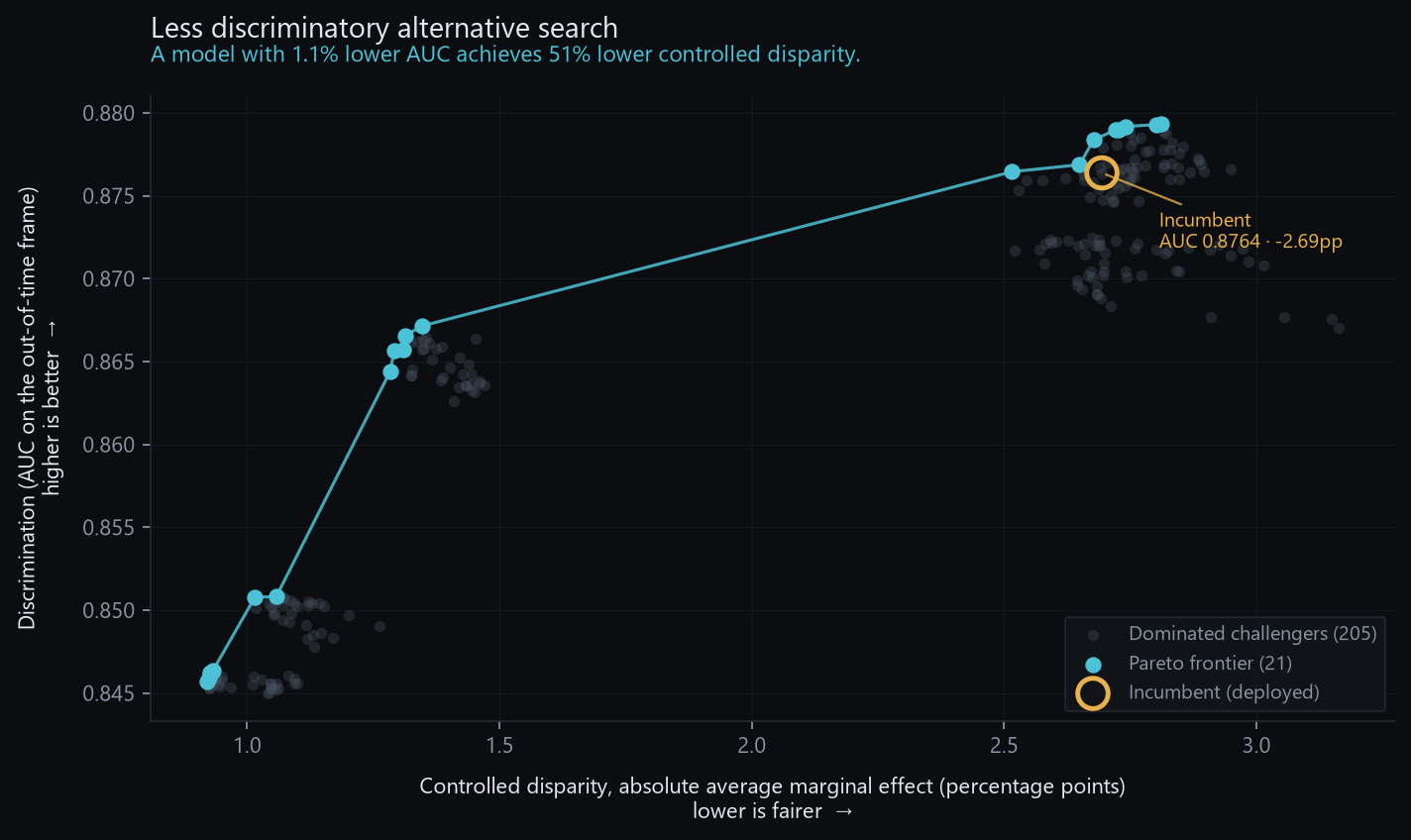
And then the question nobody can answer by inspection
Under disparate impact doctrine, a business-justified model is still
challengeable if a comparably effective, less discriminatory
alternative exists. So the system searches for one, and records the
space it searched.
—
Each point is a trained challenger. The frontier is the set no
other challenger beats on both axes at once.
The document writes itself
Twelve sections. Zero hand-written numbers.
Structured against the SR 11-7 validation pillars, cross-referenced to
EU AI Act Annex IV and ECOA. Every figure is read from an artifact that
some other command produced. Retrain the model, regenerate, and the
document describes the new model with no editing.
1 Purpose, intended use, and what it does not do
2 Data lineage, with row counts at every stage
3 Features, transformations, constraint rationale
4 Development methodology and reproducibility
5 Performance, overall and by segment
6 Stability and out-of-time validation
7 Fair lending analysis
8 Less discriminatory alternative analysis
9 Explainability and adverse action notices
10 Known limitations
11 Monitoring and revalidation triggers
12 Regulatory mapping appendix
📄
Sample validation pack
28 pages, generated in under thirty seconds
A decline also produces a real adverse action notice, built from the
ledger row rather than a re-score, carrying the ECOA notice verbatim
and the specific principal reasons. It explains why the FCRA
disclosures do not apply here instead of padding the letter with
boilerplate that does not.
The target is what the lender did, not what the borrower did. It
learns to replicate historical approval behaviour, including any
bias in it. Every disparity reported is a disparity in approval
behaviour, not evidence about applicants.
No credit score
Public HMDA excludes the single most predictive variable in
consumer underwriting. Performance here is not comparable to a
production model, and the apparent importance of the variables that
remain is inflated because they stand in for the missing one.
Clean metrics prove less than they appear to
Everything here is measured on a fixed historical extract. That
establishes properties of a model artifact. It does not establish
that a deployed system is compliant.
The search covers a bounded space
Finding no better alternative inside 226 challengers is not proof
that none exists. The space searched is recorded as an artifact so
the claim can be checked and extended rather than taken on trust.
Access
Open the working system.
Score applicants, retrieve and replay any decision, run a portfolio through
the fairness engine, compare a challenger model, and generate the validation
pack as a real PDF.
The guest session expires by itself. Accounts exist so that actions in the
audit trail have a name against them — an override records who made it,
which is the point of recording it at all.